Wednesday, February 14, 2007

Condominiums What are we buying?


What are they selling and what are we buying?

888 Vegas

It seems that just a few years ago advertisement for condominium and cooperative residential real estate was straight forward: A floor plan accompanied by the image of the building. If the building was not built, a simple architectural ink-wash rendering was provided.

Today, extravagant marketing campaigns appear to sell something other than real estate. Looking at a full page condominium advertisement in the dailies, wandering through the condominium promotional website, visiting a “condo sales boutique” (previously referred to as a sales office), or thumbing through the promotion package – I wonder if the product being sold is an apartment or a lifestyle.

Sheffield 57

Sultry images of men and women overlooking a skyline - no image of the building, no drawings of a floor plan, no real direct tie to a piece of property. At first glance I look for a logo of a women’s shoe co., or dress designer icon, or a perfume bottle. Only a few stylized letters of a stylized address and a small disclaimer text on the bottom. It must be an advertisement for Viagra.

Can one actually buy lifestyle, and for that matter, can one buy a life. If you can - let me know. I have been told to ‘buy a life’ since I was six on the playground wearing Garanimal clothing.

William Beaver House

Of course, consumers are not that naïve to think that they are buying new chique friends instead of property. A close buddy of mine lives in a building on the lower East side. He shares the floor with Victoria Secret Model Alessandra Ambrosia. If the building had a glossy sales brochure, it would actually live up to the images of beautiful barely clothed models walking around the halls. Although he has informed me that she typically wears sweatpants, rarely says hello to her neighbors and has not once invited him to a party. The point is, my friend did not buy his apartment based on a slick ad campaign and although he is an attractive guy, I do not think that he would have made it in the brochure.

With all that said; there does not appear to be any stopping of the condo marketing machine and as my professor told us in advertisement 101 “sex sells”. So sit back, relax and open the Sunday New York Times real estate section. You may see more skin then in Playboy.

Platinum

Monday, February 05, 2007

Architectural Family Tree Project

By popular demand - here is my architectural ancestral family tree.

Story Bound Beginning:
Architectural Family Tree Project.
As years and years go by, the architects on the World Wide Web sent their architectural family trees to this blog site and one after the other they were linked up until diagrammatically all the architects of the world were connected. The tree became so dense it was impossible to read until it thinned out at its origin where it inscribed one name, the first known by name, Imhotep.

Saturday, January 27, 2007

Architecture Pedigree

When we think of pedigree we may think of the Tripple Crown, or the American Kennel Club’s Best in Show. While reading ‘The Guilded Life of Stanford White', I pondered if there is a pedigree in architecture. Stanford White, before the fame of McKim, Mead & White worked as a draftsman for Henry Hobson Richardson. John Mervin Carrère, of Carrère & Hastings, was a draftsman in the office of McKim, Mead & White.
The linage’: H.H. Richardson to Stanford White to John Carrère

I started noticing a pattern that suggested that legendary architects worked for renowned architects

Inherently, every architect works under another architect in order to gain the experience needed to be accepted into the industry. Today, in the United States, aspiring architects are required by the state to work under an architect (or other applicable professions) in order to earn the necessary Intern Development Program (IDP) points and become a licensed architect. An architectural ancestry or family tree is therefore established for every architect, yet I will argue it does not establish a pedigree.

Famous architects do not grow from simple ancestry.
As the following examples illustrate, famous architects breed famous architects.

H.H. Richardson to Charles Follen McKim to Cass Gilbert
Eliel Saarinen (Gesellius, Lindgren, Saarinen) to Eero Saarinen to Robert Venturi
William Le Baron Jenney to Louis Sullivan to Frank Lloyd Wright to E. Fay Jones
Jack Pritchard (Isokon Co.) to Marcel Breuer to Richard Meier to Robert A.M. Stern
Cope & Stewardson to John Molitor to Louis I. Kahn to Moshe Safdie
Peter Behrens to Victor Gruen to Frank Gehry
Peter Behrens to Mies Van Der Rohe
Renwick Aspinwall & Russel to Bertram Grosvenor Goodhue to Raymond Hood
Auguste Perret to Le Corbusier to Jose Oubrerie
William LeBaron Jenney to Daniel Burnham to Ernest R. Graham

I know that there are a few exceptions to the rule and I am sure if one tries hard enough one can destroy my hypotheses with facts – yet it makes for a good blog entry and an interesting conversation piece (maybe only at AIA functions).

* One major exception is two of the ‘New York Five,’ Eisenman and Graves. Some can argue that these two have a linage from their mentor and promoter, Philip Johnson. However, Philip Johnson has no Architectural Lineage; he just had a lot of money.

KNOW OF OTHER ARCHITECTURAL LINIAGES, PLEASE COMMENT

Thursday, January 04, 2007

Moratorium on Capital Punishment

Has the global society grown spiritually enough that it can place a moratorium on capital punishment?
The Italian government believes so.

This past week the Italian Prime Minster, Romano Prodi, announced that Italy will push for a universal moratorium on executions. Italy has taken one of the ten non-permanent seats on the United Nations Security Council and has requested that the Security Council re-examine their proposal for a moratorium on the death penalty submitted last month.

This is not a new appeal to the United Nations. According to the BBC, Italy in 1994 and again in 1995 presented proposals for a moratorium on the death penalty.

Italy urges global execution ban – BBC News http://news.bbc.co.uk/1/hi/world/europe/6226687.stm

Since 2003, member countries of the European Union have ended the use of the death penalty in Europe by signing the European Convention on Human Rights Protocol No. 6 and No. 13. According to the European Union website, "The European Union campaigns towards the universal abolition of the death penalty. This stance is rooted in the belief in the inherent dignity of all human beings and the inviolability of the human person, regardless of the crime committed."

http://ec.europa.eu/comm/external_relations/human_rights/adp/index.htm

EU Policy On The Death Penalty http://www.eurunion.org/legislat/DeathPenalty/EurHRConvProt13Decl.htm


In the United States only twelve of the fifty states have ended the death penalty. In addition to those states, The District of Columbia has abolished capital punishment.

According to Amnesty International - Since 1973, 123 individules have been found innocent who were sentenced to death in the United States. The looming question is how many innocent people have we put to death by means of our capital punishment program in the name of public safety?

There are many arguments for why capital punishment should be abolished - from the financial aspect of an execution to the physiological understanding that a death penalty is not a deterrent. For me, there is only one line of reasoning – who gives you or me the right to extinguish life?

The late philologist, author, and philosopher, John Ronald Reuel Tolkien, said it so elegantly through his character Gandalf the Grey in The Fellowship of the Ring. “Many that live deserve death and some that die deserve life. Can you give it to them? Then do not be too eager to deal out death in judgment. For even the very wise cannot see all ends.”

Amnesty International
http://web.amnesty.org/pages/deathpenalty-index-eng

The Innocence Project
http://www.innocenceproject.org/

The Death Penalty Information Center
http://www.deathpenaltyinfo.org/

Saturday, December 30, 2006

New York State of Mind

New York City
Recently I was in Nebraska visiting family. The Continental commuter jet (ERJ-135) landed at Eppley airfield in Omaha, and in no time I was at baggage claim and then off to get my reserved rental car. At the rental desk I am asked for my driver’s license and like clockwork ‘the question’ is asked: “You’re from New York City, do you like living there?” I respond “yes”. The usual question followed, “how can you live there, it’s so large” – or – “I could never live in a city so big.”

Short tangent:
I was born, grew-up, came of age and went to college in Columbus, Nebraska. My parents moved there the year before my birth as the result of work. Both my mother and my father were from the West Coast.

Tangent on a tangent:
It was in the early seventies and when companies moved an employee they typically gave him/her (1970’s actually just him) a decent moving expenditure. My dad took the money allotted for flying a family of seven and purchased a station wagon and a travel trailer. Mom and dad trekked across the country to their new home; in what I am sure was a very “homestead” experience.
Long story short, I believe my mother felt that moving to Nebraska was a demotion, even thought my father’s job was not. Every summer she packed up the travel trailer and the kids and we were on the road. Sometimes she was so eager she wouldn’t wait until school was out and we would miss the last few weeks of class. More power to my mom and dad, they wanted to make sure that all six (I was born) experienced a world outside of our community. Because of the need to show their children a world outside the Midwest, I sometimes refer to the fact that “I breathed there, but I did not inhale”.

Back to the question, why do I like New York City?
My response is probably more than the car rental employee wants to hear, yet I’d like to dismiss the myth that New York City is so large that there is no community. There is, and I will even go as far as to say that there is more community than that of the suburb that I grew up in.

New York City shares the same social activities and assemblies (houses of worship, clubs, schools, and sports) which create friends and extended family. New York City differs in the fact that it is so condensed. Even within the suburbs of Queens, Brooklyn, the Bronx and Staten Island the distances between houses or apartments are inches not feet. In Manhattan almost within every block or two there is a deli (bodega) a dinner, a laundromat, dry cleaner, convenient store, drug store, and grocery store, a few restaurants, and clothing stores. One becomes attached to the convenience of locality and rarely ventures out to the other dry cleaner three blocks away. This proximity creates meetings of acquaintances – one starts to recognize and becomes acquainted to people within their block. I might not know the gentlemen in the local bodega and vise versa, yet I know him as the owner of the corner convenient store and he knows me as the guy who buys the Sunday New York Times, or the one who comes in at midnight for a 1/2 quart of Ben and Jerry’s Chubby Hubby ice cream. I know him so well enough that I don’t mind leaving a set of keys with him to give to a friend who will be using our apartment over the weekend when we are out of town. It is this trust and mutual connection that makes New York more personal that one might think. The late Jane Jacobs wrote about this phenomenon in her book “the life and death of great American cities”. In her example she left her child with a local merchant while she was running errands.

Additionally, the convenience of so many things so close, who needs a car? When living in the suburb of Columbus, Nebraska, if you were craving ice cream or ran out of milk or was missing that certain spice for supper, you had to get in the car, drive a few miles and 30 minutes later you had what you needed. Within a commercial break I can have anything that I need. So convenient that I do not need or want a car.

The second part of my answer, to the question of why I like New York, is more tangible and more believable for those that have not lived in the city. You never know what to expect. I enjoy the new, I like being amazed and taken off guard and this happens in New York all the time. I call this my “New York Experiences”.

My first of these “experiences” was when I was coming home from work late one evening and on the subway platform there were two musicians that I have seen before (separately) playing their instruments at different stations. This evening they were playing together – John Lennon’s Imagine. Imagine – the bagpiper wearing his Scottish highland formal outfit and a Rastafarian with thick deadlocks playing a tarbuka like drum. I was stunned, I had never heard the sound of a bagpipe and a tribal drum playing Imagine, or any other similar song before. The juxtaposition of cultures, complete with every stereotype, together as one. It was wonderful. I stood and listened to the two even though I am not a huge fan of the sound of a bagpipe. At that moment, in that spot, it was harmoniums and every time I hear a bagpipe (In New York it is frequent) I always remember this moment.

These experiences happen every day, it is the homeless man lending a quarter to a woman at a payphone, and it is walking down Wall Street at 5:00 PM and the smell of “alfalfa” filling the street. It is going to a lecture and seeing the Archi-gram group, or shopping at Duane Reade and noticing Peter Eisenman in the same aisle.

New York City is the on-going experiment of the United States; it is truly a melting pot of cultures where tolerance and understanding is the golden rule so we may all live and work together to achieve our own separate goals. This is why I like New York – Don't care if it's Chinatown or on Riverside…. I am in a New York State of Mind.


New York State Of Mind
-Billy Joel

Some folks like to get awayTake a holiday from the neighborhoodHop a flight to Miami BeachOr to HollywoodBut I'm taking a GreyhoundOn the Hudson River LineI'm in a New York state of mind I've seen all the movie starsIn their fancy cars and their limousinesBeen high in the Rockies under the evergreensBut I know what I'm needingAnd I don't want to waste more timeI'm in a New York state of mind It was so easy living day by dayOut of touch with the rhythm and bluesBut now I need a little give and takeThe New York Times, The Daily News It comes down to realityAnd it's fine with me 'cause I've let it slideDon't care if it's Chinatown or on RiversideI don't have any reasonsI've left them all behindI'm in a New York state of mind It was so easy living day by dayOut of touch with the rhythm and bluesBut now I need a little give and takeThe New York Times, The Daily News It comes down to realityAnd it's fine with me 'cause I've let it slideDon't care if it's Chinatown or on RiversideI don't have any reasonsI've left them all behindI'm in a New York state of mind I'm just taking a Greyhound on the Hudson River Line'Cause I'm in a New York state of mind.

Wednesday, December 20, 2006

Happy Holidays

Happy Holidays:
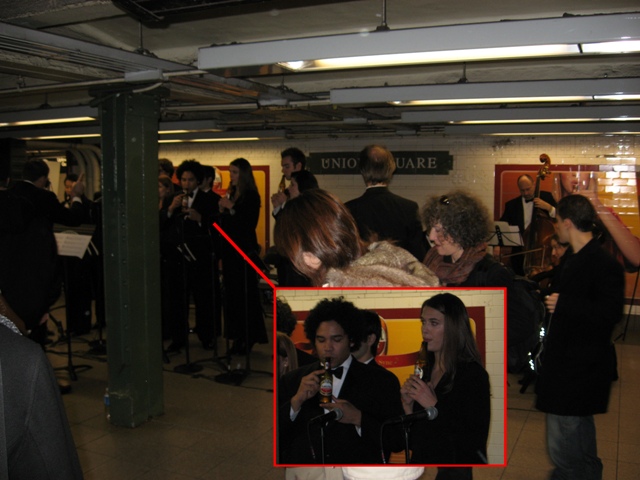
One of the most wonderful things about urban life is
'moments of the absurd' - They catch you off guard and put a smile on your face.

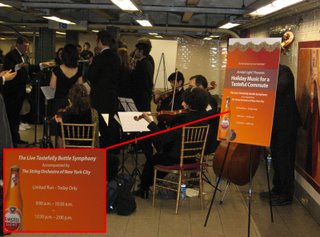
These photos were taken in the 14th Street subway station. A cleaver promotion by Amstel light marketing.

The Bottle symphony is backed up by a small chamber orchestra.


Friday, December 15, 2006

The Importance of Travel:

December marks the one month anniversary of the blog. It also marks the shift in the content of the web log to more personal accounts and thoughts - A step closer to the mission of this blog.
‘A Diary of the Mundane -An Opinion on Architecture and Urban Design -One Voice’


The importance of travel:
Within the academic world of architecture there is a phenomenon referred to as “studio life”. This is the life of a student associated with the studio component or design classes taught at architecture schools across the country. These courses differ slightly based on the curriculum of the associated school, yet one thing remains the same – students are encouraged to spend vast amounts of time in design studios. This is understandable because most studio courses are in the 5 credit range. Approximately 10 hours a week to be dedicated to study not including the actual courses time. (2 hours study outside of class for every 1 credit.)

The studio has taken on a much greater persona.
The studio is a ‘home away from home – or dorm, or fraternity / sorority or apartment’ it is located in the school of architecture which is typically situated on campus. The studio is a private study hall and a social place to hang out. When I was at the University of Nebraska, I for argument sake completely moved into the college of architecture – I studied (worked) there, I ate there, I slept there, and in fact I even took dates there. (This is as far as I will take this example.) What this routine produces is the 24-hour-work-day where there is no separation between design (work) time and personal time. This lifestyle helps solidify the future architect’s addiction for constantly working on design. (The incapability to stop designing on a project is a catastrophic flaw of architects, as noted by many accounting departments in design firms). This habit also contributes to poor time management and procrastination, inevitably spiraling into a myth and aspiration of the architecture student to burn the midnight oil, in the name of design.

Yet, in my mind, these are not the most problematic of the issues of a poorly run studio course. (Poorly run – I will address this negative connotation in the next paragraph) The most problematic is the inbreeding of ones own perceptions of architecture.

The studio professor cultivates these activities. The professor sets in motion the idea that students should take up residence in the space called ‘studio’ and share life experiences with their classmates. It is understandable - what professor wouldn’t want their student to work 24 hours a day on their assignment?
Any undergraduate who has taken an architecture studio course has a story - midnight professor/student crits, the “cool” professor having food delivered to the studio after-hours with a note “its almost over”, or projects being due in the evening (8:00pm). My favorite story is from a friend who graduated from Syracuse University. He was working toward a deadline during his second year when around 2:00am his professor came into the room after a night on the town. The professor looked around and then started taking the empty chairs of the students not currently working in the studio and placing them on their drafting boards in a somewhat forceful action. The students that were in studio all got the hint and the students that came the next day were fearful of any outcomes, particularly when it came time for grades.

Not all professors are like that; my third year architecture studio professor at the University of Nebraska was different. Although, Dr. Ted Wright did want us to work in the studio and advised us to participate in the “studio life”, he also instilled time management skills – in his words “necessary for success”. He pushed us to eat healthy and to “work hard, play hard and get eight hours of sleep”. Somehow he also managed to eliminate any sense of cut-throat competition between students. For me, this studio became the most open and interactive, sharing ideas and deep thoughts about architecture and the projects that we were all working on.

The most problematic is the inbreeding of ones own perceptions of architecture:
I recently participated in a student crit where the design challenge was combining programs: Laundromat and a sports bar; a hair salon and a gentlemen’s social club (didn’t John Allan do this?); most interesting, opera house and a discothèque. When discussing the latter project, I asked the student if she had been to the opera – she had not. I asked the other students, have you been to a gentlemen’s social club? – “no”, have you been to a Laundromat? – “I visited”.

How can an architect design an opera house if he/she has never been to an opera? They cannot. Some argue that designers can use the Ramsey and Sleeper’s Architecture Graphic Standards, but I disagree. I contend that this promotes stagnant ‘Encyclopedia Style Design’ simply inbreeding thoughts without an induction system to stir any true understanding of a space. Which brings me to the title of this post, ‘The Importance of Travel’ - The importance of experience, the importance of understanding through ones senses?

I participated in a charrette for a master plan and design of an entertainment retail development and new gateway to a city center on the East Coast. We were working out the issue of getting people from the parking structures located behind the retail buildings, through the retail zone to the street. I had just returned from London and mentioned the scale and charm of London’s shopping arcades – It became a major design element in the project.

During the same charrette we were struggling with a site/planning condition that created an awkward void enclosed by retail on the North, South and South-West, a parking structure on the West side and the main street on the East. The program did not require additional retail and the early sketches filled the space with parking. After reviewing the parking numbers and realizing that we could rearrange to leave this area void – I proceeded to mention the nice surprise that I got when turning a corner in cities of Italy and finding a piazza. These urban open spaces were created many times by the void of buildings and conversion of paths rather than any major master-plan. When I was in Otranto, Italy the piazzas were places to meet up, play street ball or park your Vespa. Many of my fondest memories were sitting at a café on the corner of a piazza drinking a cappuccino, eating a ginger biscuit and watching the locals. (Needless to say) We left the space open.
Later that day, a colleague came up to me and jokingly mentioned that I needed to stop traveling.

This day is my best example and argument for the need of one to travel in order to fully understand the environment that we are designing. Of course I could get all of these ideas from a book and I am sure that I learned about them in my 9:00am Architectural History class where for two hours (with the lights off) a teacher showed slides and all the students got their required shut-eye. Yet, to really understand the scale, the proportions and the social themes, one has to see it physically, one has to experience it.

When it is time for me to teach a studio course, I have a choice – I can be the studio professor that I had as a student who requested that the undergraduate buy these three important books that will cost $70.00 or to be a studio instructor that gives the students a choice to either buy the important books –or- take that $70.00 and go to the opera, go see a show / concert, become a member of a museum (I recommend the Frick Collection), or just go to the ‘hole in the wall’ coffee house that has the greatest jazz or poetry readings in the area. Do your laundry at the laundromat, buy food at the farmer’s open air market and/or not defer your jury duty for the third time …
-To be there and engaged is the only way one can capture the real meaning of a space.-


_______________________

On a Tangent:
Can someone understand and “design” a successful and advanced foreign policy if they have limited foreign travel and have not bare witness to the complexity of traditions, customs, philosophies and opinions?

"George W. Bush had only visited Mexico, Israel and China before
becoming president…”
A quote from CNN's Walter Rodgers:
CNN Student News: Judy Woodruff's Inside Politics
http://cnnstudentnews.cnn.com/TRANSCRIPTS/0312/17/ip.00.html

“It is ludicrous to simplify civilizations to black and white, right and wrong, good and bad, 0’s and 1’s. We are all humans, with traditions, and customs, philosophies and opinions. The more one learns about others, the more we will learn about ourselves. Understanding leads to open-mindedness that leads to acceptance.”
A quote from J. Steven Lovci
http://jstevenlovci.blogspot.com/2006/11/new-hope.html

“The most enjoyable accounts is when I have the opportunity to sit down at a ‘salon de tea’ or café, or coffee bar - take off all my filters and just observe - soaking in with my senses everything that one moment in time has to give to me.”
A quote from J. Steven Lovci
http://jstevenlovci.blogspot.com/2006/11/moment.html

Tuesday, December 12, 2006

Rambling of a Madman – Sketchbook 1996

Reading, Writing, Arithmetic
Common Humanity
Stress, Values, Ethics
Enlarged Vocational

We are prepared for a(n) academia, not a job
We are prepared for a career, not a job
Education to us that is not successful is useless
What has your architectural education done for you?
What have we learned here?

'10 year' sleepy professors
He who dares nothing but '10 year' of past risk
Wallows in the mediocrity of the power of one
Don’t be consumed by…fancy images and empty thoughts

Question, Observe, Critical
Alice in Wonderland
Lost, Confused, Etcetera
Meets the Euphoric Cat
Lookup Comment

'10 year' proactive professors
She who dares design is a vision of how the world should be
'10 year' + '10 Year' + '10 Year'…. n Years
Be prepared for the unknown future
Jam-packed, filled-up, chock-full possibilities happen

Self motivation for continuing education
Look around-look around nothing is new it is just renewed
Rethought, Repackaged, Redone
It is the History of the Future of the History of the Past

WAKE UP GOOD DESIGN IS A GOOD INVESTMENT.


The year was 1996 (10 years ago) I was in my 4th year of Architecture School. The poem / compilation of thoughts is from my sketchbook of that semester.

Friday, December 08, 2006

Habeas Corpus

Background:

A number of months ago, I sent out a mass email regarding the elimination of Habeas Corpus in the United States of America on behalf of ‘National Security’.

Update:

Habeas Corpus - 'hA-bE-&s-'kor-p&s
From Medieval Latin, “you have the body” or “you should have the body”

Habeas Corpus is the right of a citizen to obtain a ‘writ of habeas corpus’ as a protection against illegal imprisonment. This writ allows a citizen to question before a judge whether his/her detention is legal.

Without Habeas Corpus, any American Citizen (you or I) can be arrested and detained in the United States indefinitely without having the opportunity to go before a court of law to determine if (you or I) are illegally imprisoned.

This week Senators Arlen Specter (R-Pa.) and Patrick Leahy (D-Vt.) have introduced the Habeas Corpus Restoration Act of 2006.

The bill would restore basic legal and human rights for 12 million lawful permanent residents in the United States that were rolled back as a result of the passage of the Military Commissions Act of 2006.

Patrick Leahy (D-Vt.)
http://leahy.senate.gov/press/200612/120506.html

-------------------------------------------------------
Please contact your Senator and House of Representative to voice your support or non-support of this bill.

Senators of the 109th Congress
http://www.senate.gov/general/contact_information/senators_cfm.cfm

House of Representatives of the 109th Congress
http://www.house.gov/

-------------------------------------------------------

The Death of Habeas Corpus
By Keith Olbermann
http://www.msnbc.msn.com/id/15220450/ [MSN Countdown]
Updated: 1:35 p.m. ET Oct 11, 2006


KILLING HABEAS CORPUS - Arlen Specter’s about-face.
by JEFFREY TOOBIN
http://www.newyorker.com/fact/content/articles/061204fa_fact [New Yorker]
Posted 2006-11-27


Wednesday, November 29, 2006

Is it the salesman or the merchandise that makes the trade?


there’s a dream worth a –dreamin’
And you want to see that dream come true
There’ll be plenty people talkin’,
Say forget all about it
Say it isn’t worth all the trouble,
All the trouble that you’re goin’ through
Well, what can you do?

You can’t take no for an answer
No, no, no!

Whatcha gonna do when the times get tough,
And the world’s treatin’ you unkind?
You’ve got to hang on to your optimistic outlook
And keep possession of your positive state of mind.

-Dr. Teeth

Sunday, November 26, 2006

Moloch

Moloch whose eyes are a thousand bind windows! Moloch whose skyscrapers stand in the long streets like endless Jehovahs! Moloch whose factories dream and creak in the fog! Moloch whose smokestacks and antennae crown the cities Moloch whose…
Howel, by Allen Ginsberg

I am aware that Mr. Ginsberg never wanted his poems reduced to sound bites, and forced publishers to publish his pomes in whole. But I am not Mr. Ginsberg and this is my favorite bite. In addition, wouldn’t it be in the spirit of Allen to go against what one of authority desires? This section of Howel bewitched me, perhaps it is its reference to the built environment, or perhaps it is just Mr. Ginsberg’s love of words and the imagery that they construct.

A New Hope

Many that live deserve death. And some that die deserve life. Can you give it to them? Then do not be too eager to deal out death in judgment. For even the very wise cannot see all ends.
The Fellowship of the Ring, by JRR Tolkien

It is ludicrous to simplify civilizations to black and white, right and wrong, good and bad, 0’s and 1’s. We are all humans, with traditions, and customs, philosophies and opinions. The more one learns about others, the more we will learn about ourselves. Understanding leads to open-mindedness that leads to acceptance.

Thursday, November 23, 2006

The Dirham

How can you get very far,
If you don’t know Who You Are?
How can you do what you ought,
If you don’t know What You’ve Got?
And if you don’t know Which To Do
Of all the things in front of you,
Then what you’ll have when you are through
Is just a mess with out a clue
Of all the best that can come true
If you know What and Which and Who.
The Tao of Pooh, by Benjamin Hoff p.58

Monday, November 20, 2006

Prospect

We can lift ourselves out of ignorance, we can find ourselves as creatures of excellence and intelligence and skill...

Don’t believe what your eyes are telling you. All they show is limitation. Look with your understanding...
Jonathan Livingston Seagull, by Richard Bach

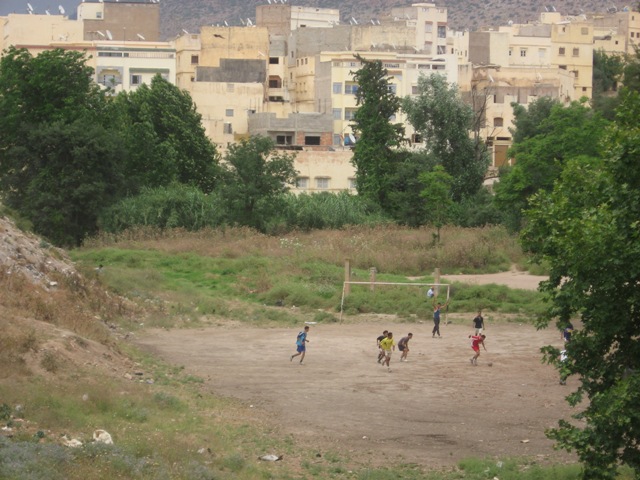
This image embodies the future of Morocco.
This is a group of young men that were playing football in the streets of Fez.

Sunday, November 19, 2006

Uncharted

Sooner or later this happens to every dedicated tourist: he ventures beyond the guidebook itinerary and discovers that the workday surrounding world reminds him of the art-historical world of the gallery; he looks out of the train window and discovers to his surprise that the countryside shares many of the traits of the city – the parish church, the layout of the fields, the glare of the sun in a village street are recognizable variations on their city counterparts; city and country belong together in a unique landscape, and this newly discovered entity seems far older, far more venerable than the oldest monument.
The Necessity For Ruins and other Topics, by J.B. Jackson p. 9

Sunday, November 12, 2006

The Traveler - Part 2

And after years the boy came back, both of them were old."I really cannot help you if you ask for another gift.""I’m nothing but an old stump now. I’m sorry but I’ve nothing more to give""I do not need very much now, just a quiet place to rest," The boy, he whispered, with a weary smile."Well", said the tree, "An old stump is still good for that.""Come, boy", he said, "Sit down, sit down and rest a while."And so he did and Oh, the trees was happy. Oh, the tree was glad.
The Giving Tree, by Shel Silverstein
(Transcript of Reading)

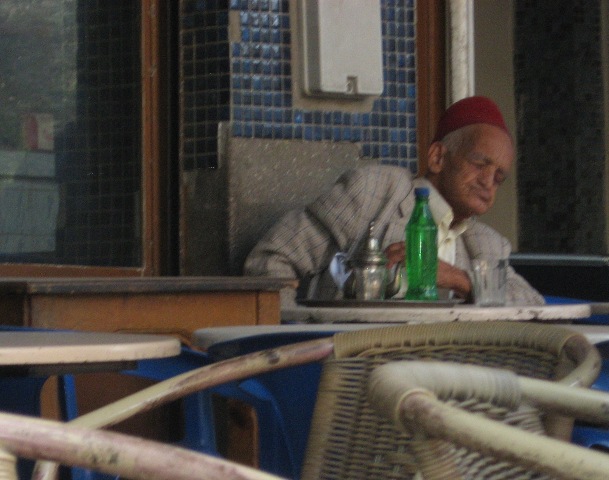
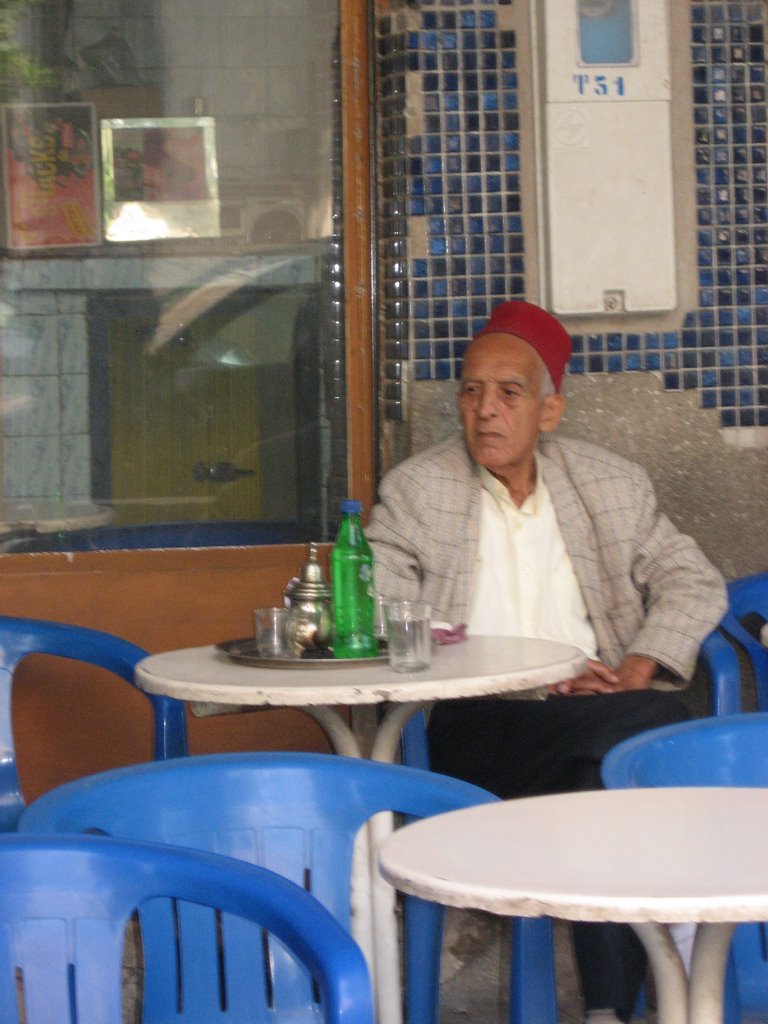
Correction: This gentleman is an inhabitant of Sefrou, Morocco.
“Yet I am sure he is dreaming of the port in Mogador (Essaouira)”
see ‘The Traveler’

Friday, November 10, 2006

A Moment

The creatures who act as though they belong to the world follow the peace-keeping law, and because they follow that law, they give the creatures around them a chance to grow toward whatever it’s possible for them to become.
Ishmael, by Daniel Quinn p.245

The most enjoyable accounts is when I have the opportunity to sit down at a ‘salon de tea’ or café, or coffee bar - take off all my filters and just observe - soaking in with my senses everything that one moment in time has to give to me.

Moroccan Road

Something, someone, some spirit was pursuing all of us across the desert of life and was bound to catch us before we reached heaven. Naturally, now that I look back on it, this is only death: death will overtake us before heaven. The one thing that we yearn for in our living days, that makes us sigh and groan and undergo sweet nauseas of all kinds, is the remembrance of some lost bliss that was probably experienced in the womb and can only be replaced (though we hate to admit it) in death.
-On The Road, by Jack Kerouac p. 124

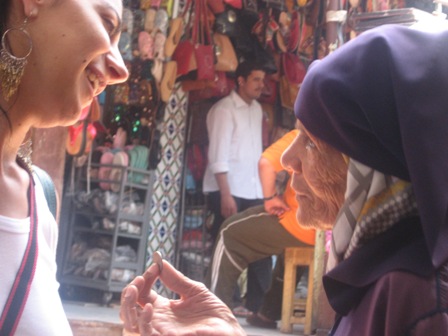
Perhaps this photo is excessively literal.
Nevertheless – These photos are moments which I have bare witness to Morocco’s frayed edges which have so much to tell us.
It is the frayed edges that are the edges of substance for us all to learn from.

Thursday, November 09, 2006

The Traveler

He did not think of himself as a tourist; He was a traveler. The Difference is partly one of time, he would explain. Whereas the tourist generally hurries back home at the end of a few weeks or months, the traveler, belonging no more to one place than to the next, moves slowly, over a periods of years, from one part of the earth to another. In deed, he would have found it difficult to tell, among the many places he had lived….
-The Sheltering Sky, by Paul Bowels p. 14

This gentlemen is an inhabitant of Mogador, Morocco.

Casablanca, Morocco

Everything has its personal legend, but one day that personal legend will be realized. So each thing has to transform itself into something better, and to acquire a new personal legend, until, someday, the soul of the world becomes one thing only.
- The Alchemist by Paulo Coelho p.151

This is a photo taken in Casablanca, Morocco at the Mosque of Hassan II.
When I look at this photo, I always wonder what this man is pondering.
His memories, his life, his family, perhaps where he left his keys.